Simply put: because the next customer of your organization may not be a human.
Over the past period, we kept noticing the same thing in many discussions, with organizations from very different sectors: the API is still treated as a side topic.
In one discussion with a manager at a company that sells a SaaS product, the picture was clear. Their APIs were exposed directly, with no API Gateway and no API Management layer at all. The documentation, where it existed, was very basic.
When we raised why this matters, the answer was: "Things are working... there is a separate Word file documenting some of the APIs, and that's it."
In another case, we needed to integrate with an HR solution to automate some internal processes in our own company. The solution had APIs, but with no best practices, no governance, and no commitment to security standards.
The result? We had to go back, patch things up, and write custom code just to be able to work with those APIs.
Two different stories, one root cause: we still treat the API as a technical detail, not as a business asset.
Why was the API a side topic in the first place?
Let's start from the basics.
For a long time, the role of the API was clear and limited. It was a technical bridge between two systems: an integration project done once, between known parties, and then forgotten.
With that logic, API Management looked like a luxury. Why put a gateway, documentation, and governance in place for something used by one or two partners?
That logic made sense in the past. It doesn't anymore, because three things have changed.
1. The API is now a product, not just a bridge
Today, the API is no longer only a way to connect systems. It is a product an organization can sell, build partnerships on, and use to generate revenue.
This is not just theory. Gartner points out that products designed with an API-first and composable approach will form a major competitive moat for the organizations that build them this way [1].
But a product with no documentation, no protection, and no clear way to consume it... won't sell. It stays an integration project dressed up as a product.
2. The new consumer of your API is the AI agent
This is the biggest change, and the fastest.
AI agents will be the ones making decisions and taking actions on behalf of the user: booking, paying, comparing, buying, and submitting requests.
And the numbers tell the same story:
| Gartner prediction | Figure |
|---|---|
| Share of the increase in API demand coming from AI and tools using LLMs, by 2026 [2] | More than 30% |
| Enterprise apps featuring task-specific AI agents by the end of 2026 (up from less than 5% in 2025) [3] | 40% |
| B2B purchases that will go through AI agents by 2028 [1] | 90%, worth more than $15 trillion |
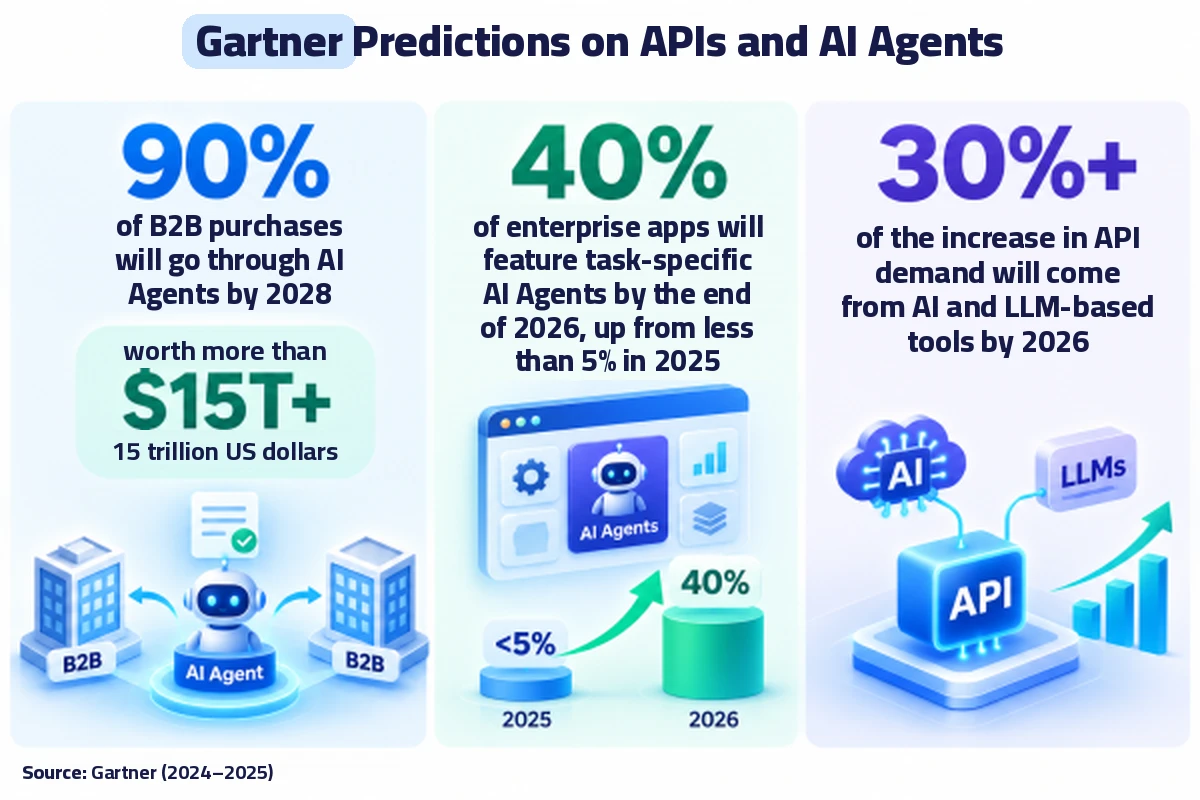
So how does an agent deal with your organization? It doesn't read your brochure. It doesn't call your sales team. It doesn't attend a demo. The agent reads your API.
It needs to know that your organization offers APIs in the first place. It needs to understand them and know how to talk to them. And it needs to trust that it can work with them safely and smoothly.
And if it can't find that?
Important
The agent doesn't complain. The agent moves on. It skips your organization and goes to whoever is ready. That is how organizations start losing quietly: losing visibility, losing partnerships, and losing money, without anyone telling them why.
3. The risks have changed completely
In the past, an API was consumed by a known partner, under a contract, with a predictable volume of usage.
Today, an agent can make hundreds of calls in seconds, reach data it shouldn't see, and handle credentials in ways nobody planned for.
This is exactly what worries technology teams. According to Postman's 2025 State of the API Report, with more than 5,700 developers and professionals taking part [4]:
- 50.8% say their biggest fear is unauthorized or excessive calls from AI agents.
- 49% worry that AI systems will reach data they shouldn't access.
- 46% worry about API credentials leaking.
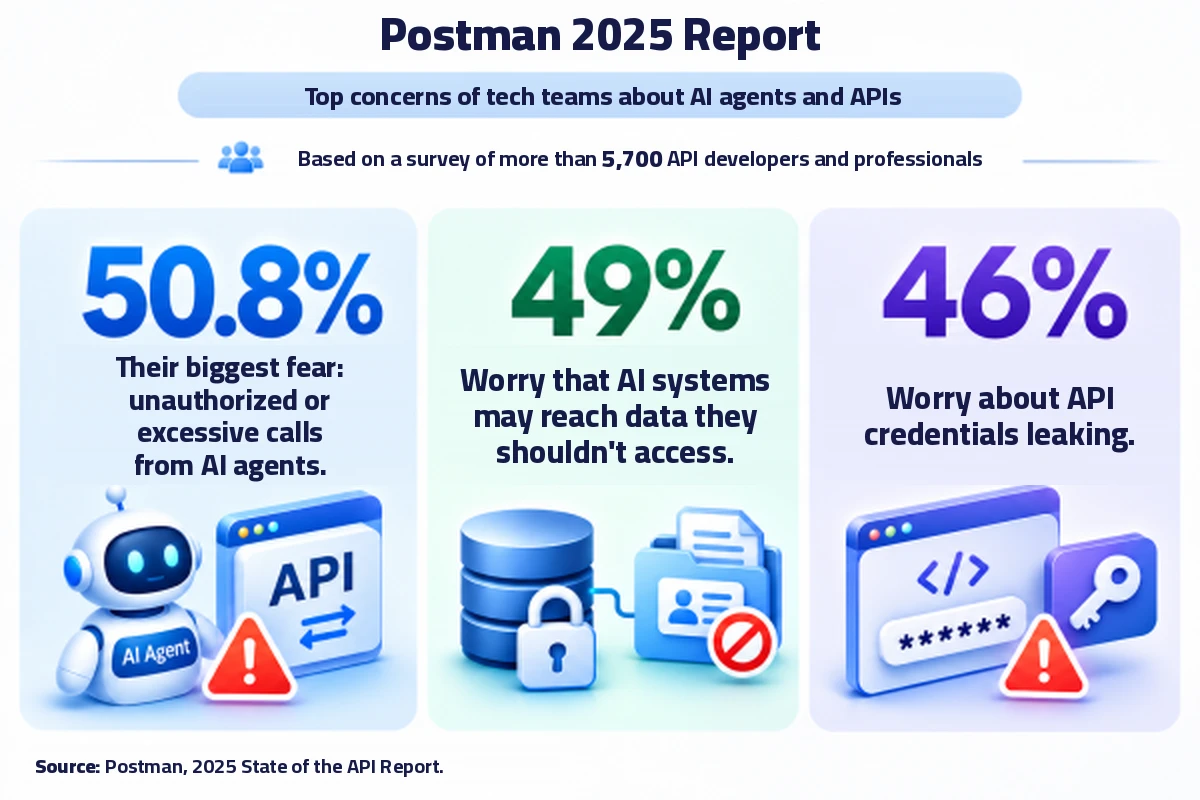
The question here is simple: if the API is exposed directly, with no gateway, no rate limiting, and no clear identity for who is calling... who is going to stop this?
What does API Management actually mean?
Let's be precise. API Management is not a product you buy, install, and forget. And it is not just a gateway.
It is a way of managing the API as a business asset, from the moment it is built until the moment it is retired. Put simply, it stands on three pillars:
| Pillar | What it covers |
|---|---|
| Security & Control | A gateway in front of the APIs, a clear identity for every consumer, permissions, and rate limiting, whether the consumer is a human or an agent. |
| Clarity & Discoverability | Clear, accurate, always up-to-date documentation, ideally generated automatically from the APIs themselves, and in a machine-readable format, not only human-readable. Because an agent doesn't read PDFs. |
| Governance & Observability | Unified design standards, versioning, and a clear owner for every API, plus full visibility into everything happening on your APIs. This pillar deserves its own section. |
On top of these three pillars comes the agent-readiness layer, such as MCP. This layer isn't built on nothing. It is built on an API that is properly managed.
Observability: what you can't see, you can't manage
Knowing that your API is up is not enough. You need to see everything your consumer is doing, whether that consumer is an application built by a developer, or an agent.
With a regular consumer, the questions are clear: Who are they? Where are they? Which APIs do they use? How much are they consuming?
With an agent, the questions go deeper: Where did it come from? Where is it located? Which credentials did it use? When did it arrive and when did it leave? And what was the full series of calls it made from start to finish?
This is the difference between traditional monitoring and full observability. Monitoring tells you there is a problem. Observability tells you who, how, and why.
Its value shows up on four levels:
- Security. A credential alone is no longer proof of good intent. According to Salt Labs, 99% of the attack attempts they analyzed came from authenticated sources, meaning parties that already had access [5]. What reveals the problem is the behavior, not the key.
- Understanding behavior. An agent doesn't behave like a human, or like a traditional application. When you understand how each consumer behaves, you can set permissions and rate limits based on reality, not on assumptions.
- Business decisions. Consumption is the basis of pricing. When you know who is consuming, how much, and from which API, you know what your real product is, and where the opportunities are.
- Accountability. When an agent takes an action on behalf of a user, you must be able to trace back: who delegated, who executed, and when. This will become a key question in any dispute or audit.
An API you can't see is an API you can't protect, can't price, and can't grow.
"Things are working"... but for how long?
Let's go back to the HR solution story. The solution itself was a very strong SaaS product. But the lack of standards and governance in its APIs didn't disappear... the cost simply moved to us.
With all the custom code we had to write, our team started asking: why don't we just build our own module and be done with it? And there was a real push in that direction inside the company, because relying on that solution for integration had been such a poor experience.
But we are not an HR company, and building an HR system is not our business. So we started looking for another provider, one with proper APIs.
And here is the important point. We are a human partner. We can be patient. But sometimes we don't have the time to search for a new solution, go through a full procurement cycle, and replace the whole system just to get an integration working. That in itself is a cost.
Even so, because of how much it was costing us, and because the solution no longer fully met our needs, we will most likely replace it completely.
In other words, weak APIs didn't only cost us... they cost the provider a customer.
If that is how a human partner behaves, one with patience and a real interest in making it work, how will an agent behave?
The agent doesn't have that patience. It won't patch things up, it won't write custom code, and it won't pick up the phone to ask. It won't even skip you... it won't look at you in the first place. It will go straight to the organization whose APIs are clear, protected, and ready.
That is why "things are working" may be true today. But it measures the present, not readiness for what's coming.
Where should you start?
This doesn't need a massive project or a decision to rebuild everything. The start is practical and gradual:
- Know what you have. Build an inventory of all exposed APIs, internal and external, ideally an automated one. According to Salt Security, only 24% of organizations have a complete, automated API inventory [5]. The rest rely on partial or manual tracking.
- Put a door before you open the house. A gateway in front of your APIs, with identity, permissions, and rate limiting.
- See everything. Full observability from day one, not after the first incident.
- Make documentation part of the API itself. Not a separate file that is updated by hand and goes out of date.
- Assign an owner to every API. Because an API with no owner has no future.
- Then think about agents. Once the foundation is ready, the AI layer becomes a natural next step, not a gamble.
Conclusion
In the past, the API was a bridge between two systems. Today, it is the door through which your partners, your customers, and the agents working on their behalf come in.
The question is no longer: "Do you have an API?"
The real question is: is the door clear, protected, and ready to welcome them?
The organizations that answer this question today are the ones that will be on the map of tomorrow's agent-driven economy.
At Digitinary, this is exactly what we work on through Wasl, our API Management platform: from the moment an API is built, until it becomes a clear, protected product under full observability [6].
References
- Gartner, "Gartner Unveils Top Predictions for IT Organizations and Users in 2026 and Beyond," Oct 2025. cxotoday.com
- Gartner, "Gartner Predicts More Than 30% of the Increase in Demand for APIs Will Come From AI and Tools Using LLMs by 2026," Mar 2024 (Adrian Lee, VP Analyst). datanami.com
- Gartner, "Gartner Predicts 40% of Enterprise Apps Will Feature Task-Specific AI Agents by 2026, Up from Less Than 5% in 2025," Aug 2025. gartner.com
- Postman, "2025 State of the API Report," Oct 2025 (5,700+ respondents). businesswire.com
- Salt Security, "Salt Security Research: As AI Agents Outpace Security, Most Organizations Face an Unsecured API Surge" (State of AI & API Security Report, 1H 2026), Apr 2026 (327 security leaders). salt.security
- Wasl API Management Platform. Manage your full API lifecycle on one lightweight, development-oriented API platform and ensure compliance. digitinary.com/wasl