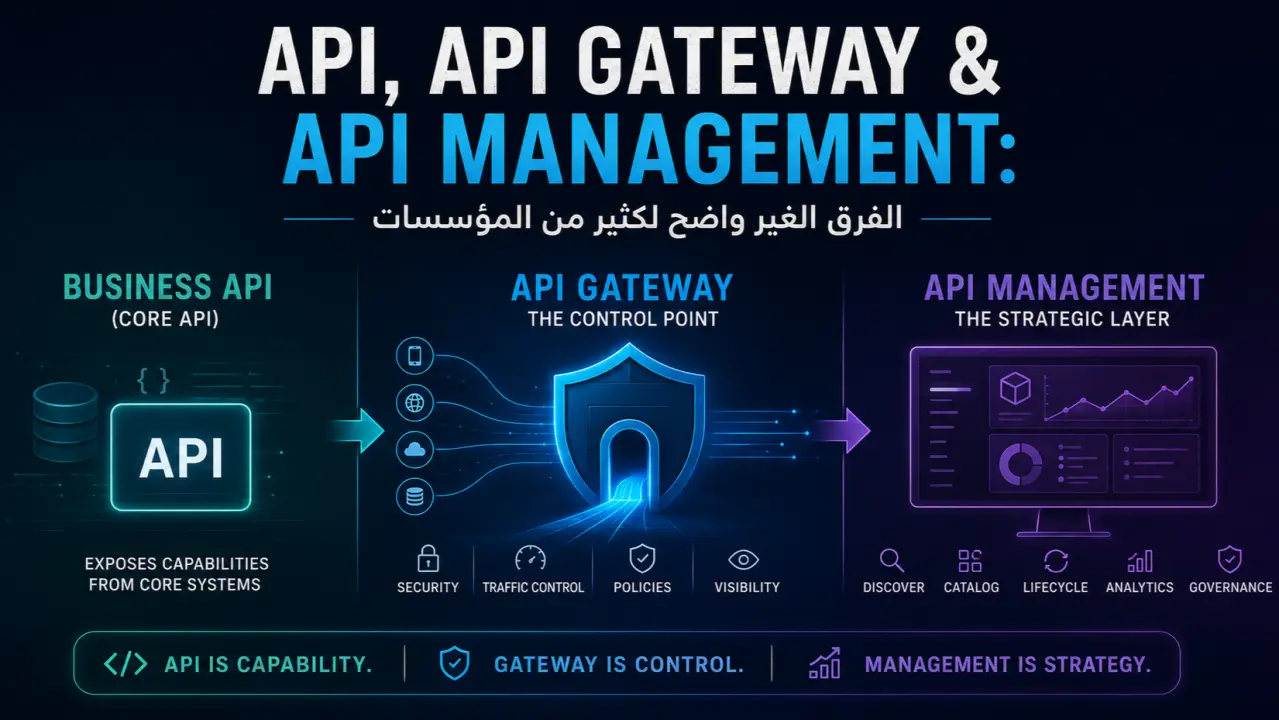
In more than one meeting, we have heard the same mix-up: someone says "API" when they mean the gateway, or "the gateway" when they mean the whole management strategy. It sounds like a small detail. It is not. Each of these three terms describes a different layer, solves a different problem, and needs a different decision from leadership. Confusing them leads to the wrong investment, and sometimes to skipping a step the organization actually needs.
Here is a short story we keep running into, in different forms.
A bank decides to expose a new digital service to a partner. The technical team builds an API quickly, tests it, and connects it directly to the partner. It works. Six months later, three more partners want the same thing, then five more internal systems need it too. Now there are dozens of direct, uncontrolled connections, each with its own way of handling security, logging, and versioning. Nobody can say for certain who is calling what, or which connection would break if a core system changed. This is exactly the point where the absence of an API Gateway turns from a technical shortcut into an operational risk.
So, What Is an API, Exactly?
An API (Application Programming Interface) is a technical contract between a system or application (the core system) and the outside world. It exposes a specific piece of functionality in an organized, secure way, the data it gives you, and the way you are allowed to request it.
"The data it gives you, and the way you are allowed to ask for it."
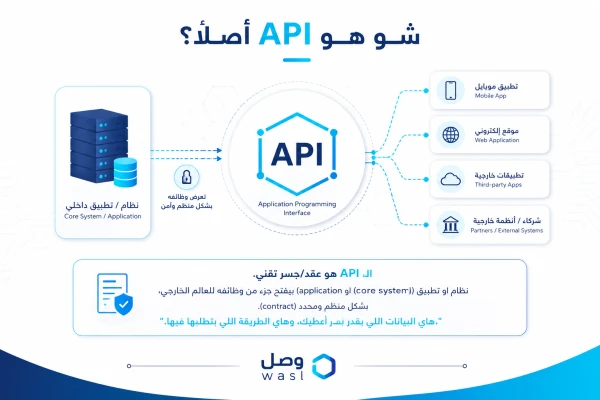
Every core system or internal application in your organization can expose its functionality safely and in an organized way to the outside world, whether that is a mobile app, a website, a third-party application, or a partner or external system. That is the job of the API on its own: exposing capability. Nothing more.
API vs API Gateway: The Difference That Gets Missed
The problem starts when the number of APIs grows. If every mobile app, website, partner, and external system connects directly to your core systems, each with its own security model and its own retry logic, the number of connections you need to manage does not grow one at a time, it grows the way full-mesh integration always does: with n systems, you can end up managing roughly n(n-1)/2 direct connections. Ten systems means up to 45 connections. Twenty systems means up to 190. Every one of them is a separate point of failure, a separate thing to secure, and a separate thing to monitor.
This is exactly where the API Gateway comes in, as a single control point in front of all of these APIs.
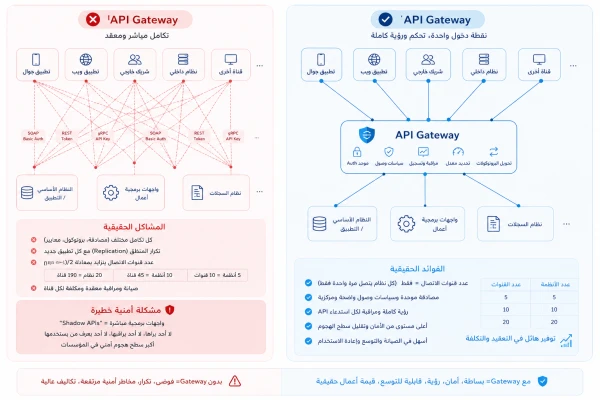
Without a gateway, every connection is direct and complex: mobile apps, web applications, partner systems, other internal systems, and other channels, all wired straight into the core systems and internal applications, each with its own authentication method (SOAP Basic Auth, REST API Key, gRPC mTLS, or something else entirely), and each one a separate replicated integration. With around 20 channels, that can mean up to 190 direct connections to secure and maintain, and a level of technical debt and operational complexity that only grows heavier with time.
With a gateway, all of that traffic passes through a single control point that gives you real visibility and governance: unified access policies, monitoring and control, and one place to apply security. The real benefit is not just fewer connections (a jump from up to 190 direct connections down to as few as 5 gateway channels in the same scenario), it is a real reduction in risk, a higher, consistent level of security applied uniformly, and easier auditing and compliance.
There is also a security risk that deserves its own spotlight: the Shadow API problem. These are undocumented or forgotten APIs still running somewhere in the organization, outside anyone's visibility or governance. They are one of the most dangerous entry points for a security breach today, precisely because nobody is watching them. A gateway does not just organize traffic, it is also your first line of defense against exactly this kind of hidden risk.
The Level Above Both: API Management
Once you have the gateway in place, a new question shows up: how do you manage the full lifecycle of every API, from the day it is designed to the day it is retired? That is where API Management comes in, as the strategic layer that sits above both the API and the gateway.
API Management covers discovering every API across the organization, cataloging them so teams can actually find and reuse what already exists, managing each one's lifecycle from design through deprecation, tracking usage and performance through analytics, and applying governance consistently across the whole API portfolio. In short: the API is the capability, the gateway is the control point, and management is the strategy that ties everything together.
Why the Region Still Has a Gap Here
According to Adobe's 2025 research on digital transformation in the Middle East, only 57% of organizations in the region have adopted a partial API-based architecture, and only 54% rate their own API management maturity as "medium effectiveness." These are not small numbers. They mean that roughly half of the organizations we work with are still exposed to the same risk: APIs built without a gateway, and gateways running without a real management strategy behind them.
Where Should You Start?
If your organization is building APIs without a gateway in front of them, that is the first gap to close, before the number of direct connections grows any further. If you already have a gateway but no clear API management strategy, that is your next step: proper cataloging, lifecycle management, and consistent governance across every API you own.
The difference between these three layers is not a matter of terminology. It is a matter of how ready your organization is to scale safely, secure itself properly, and grow its digital ecosystem without piling up technical debt it will have to pay back later.